
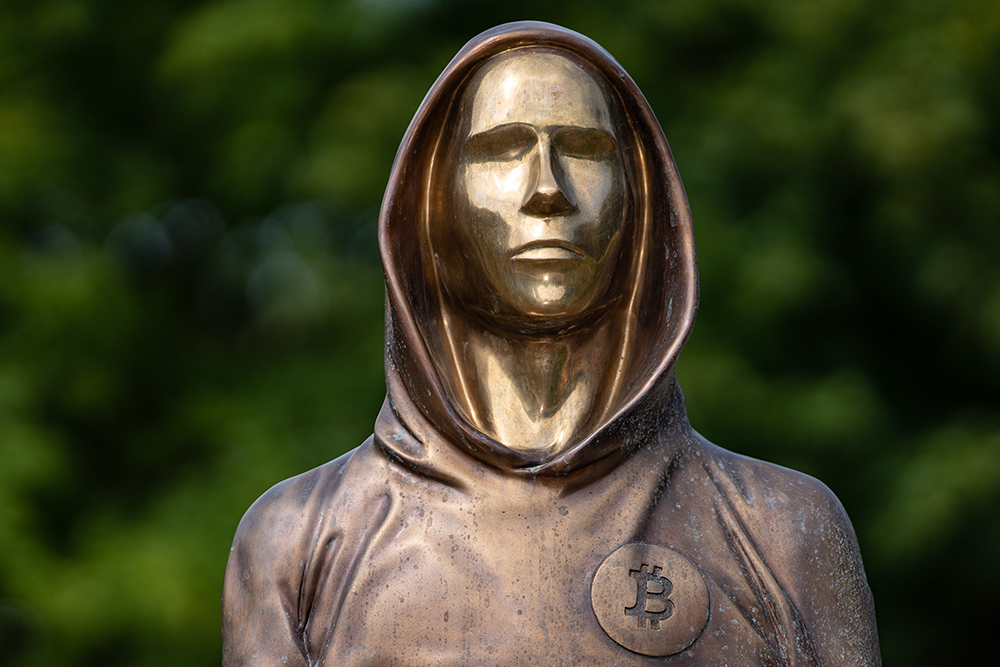
On October 31, 2008, someone writing under the name Satoshi Nakamoto posted a nine page PDF to a cryptography mailing list. You can still read the Bitcoin white paper in about twenty minutes. The abstract opens with a sentence about letting online payments go directly from one party to another without a financial institution in the middle. That was the whole pitch. Cash, for the internet, that nobody has to ask permission to use.
This October 31 marks eighteen years. In human terms, the white paper is old enough to vote. In financial terms it has outlived a long list of people who said it would be gone by the following spring.
Most of the anniversary coverage this week will be about price. We’d like to spend a few minutes on the sentence Satoshi wrote the paper for, because at Athena we see what it means in person, at a kiosk, every single day.
The World Bank’s Global Findex 2025 puts the number of adults with no account anywhere, at a bank or a mobile money provider, at 1.3 billion. That’s a record low. It is also more people than live in the entire Western Hemisphere. Women make up 55% of them. Around 900 million of them own a mobile phone, and roughly 530 million of those phones are smartphones. A phone in the pocket and no account to put it to work.
The United States likes to think of this as someone else’s problem. The FDIC’s 2023 survey counted 5.6 million unbanked American households, 4.2% of the country. Add the underbanked, households with an account who still rely on money orders, check cashers or payday lenders to get through a month, and you’re at another 19 million households. Roughly one in five American homes is either outside the banking system or standing in its doorway.
Ask why and the answers are ordinary. The most common reason an unbanked household gives is that they can’t keep the minimum balance. The second is that they don’t trust banks. Working age households with a disability are unbanked at three times the national rate. Single parent households, more than five times. People whose income swings from month to month show up over and over in that data.
Here’s what no account looks like on a Tuesday. Your paycheck is paper, so you pay a fee to turn it into cash. Rent is a money order, another fee. You want to send $200 home to your mother in San Salvador and the storefront quotes you a cut plus a wait plus a form. Savings live in a drawer, which means they can be stolen, and they can’t earn anything, and if you have to leave town in a hurry they fit in your pocket or they don’t come at all. Credit is whoever will lend to you, on whatever terms. The system was never built with these households in the room.
Read the paper again with that Tuesday in mind and it stops sounding like a technical document. A way to hold value that no one can freeze or take, that costs nothing to store, and that goes wherever you go. A way to send that value across a border for the price of a transaction fee, settled in minutes, with no one deciding whether you qualify. A ledger that treats a dishwasher in Dallas and a hedge fund in Greenwich exactly the same, because it doesn’t know which is which. Ownership you can prove with twelve words you memorized, which is the only kind of property that can walk through a checkpoint unseen.
Plenty of people with a checking account and a 401(k) treat Bitcoin as an investment, and that’s fine. Someone who was never offered the account sees something else in it: the first financial system that didn’t require an application.
The first financial system that didn’t require an application.
There’s a catch Satoshi didn’t solve, and it’s the one that matters most to the 1.3 billion. The white paper describes electronic cash. It says nothing about how a person holding physical cash gets in. Every unbanked household on earth runs on paper money, and every path into Bitcoin that gets written about, exchanges, brokerage apps, bank transfers, starts with a bank account. The door the paper opened sat behind another door that was already locked.
That gap is the entire reason a Bitcoin ATM exists. A kiosk takes the one thing every unbanked person already has, cash in hand, and turns it into the thing the white paper described, in a few minutes, in a grocery store or a gas station they were already walking into. Nobody asks for an account. A phone and a twenty dollar bill.
Athena has been running Bitcoin ATMs since 2015. For most of those eleven years the kiosk did one job, cash to Bitcoin, and that job alone put a self custodied wallet within reach of anyone with a phone. Your coins go to a wallet only you control. There’s no balance sitting with us. That was the white paper’s idea, delivered through a touchscreen, across thousands of locations in 28 states.
This year the kiosk started doing the rest of that Tuesday.
Walk up to an Athena kiosk near you with cash and send it to family in El Salvador. The person on the other end picks it up at any Red Cusca location, open 365 days a year, or has it dropped into an account at one of seven Salvadoran banks. The sender shows up with cash and a phone, and that’s the whole requirement. The fee and the exact amount arriving show on the screen before a single bill goes in, which is more than most storefront remittance counters can say. Mexico is next on the list, with Guatemala and Honduras behind it.
The same kiosk sells gift cards and mobile top ups for cash, delivered to an email inbox in seconds. For a household that pays for everything in paper, that’s a way to shop online or keep a prepaid phone running without a card on file anywhere.
For customers at the other end of the scale, Athena OTC handles large trades with direct execution and a dedicated desk. Same company and the same rails, at a different size of transaction.
Put those together and the kiosk in the corner of the grocery store has become something the white paper didn’t quite anticipate: a cash on ramp to the whole list. Save. Send money home. Buy things online. Hold wealth that crosses a border in your head. Each one for a person the banking system had already decided not to serve.
The Findex numbers moved five points in three years, and nearly all of that movement came from a phone and a service that met people where they already were. Account ownership in developing economies grew because mobile money showed up at the corner shop. Nobody got banked by a branch that opened downtown.
We think the same thing is true here. The next hundred million people who use Bitcoin the way the white paper intended will walk into a store they already shop at, pick English or Spanish on a screen, feed in cash, and walk out holding something no one can take from them that works in any country they land in. A brokerage app that opens with a Social Security number and a linked checking account was never going to reach them. Some of them will send money home first and buy their first Bitcoin six months later. Some will never buy any and will still have a cheaper, faster way to reach their family. The kiosk doesn’t need to know which one you are.
Satoshi wrote nine pages so the internet could have cash. Athena’s job for the last eleven years has been making sure the people who actually use cash get to come along. Happy eighteenth to the paper that started it, from the company that puts it on a sidewalk.
Find an Athena kiosk near you and see for yourself what it does now.
New to the paper itself? We walked through what it says in The Bitcoin Whitepaper: What Started It All.
Own the future.


Find a Bitcoin ATM by state
3,500+ Athena locations across 28 states.
Athena XP Partners
Pick the model that fits and answer a few questions. Our partnerships team will follow up within one to two business days.
Thank you. Someone from our partnerships team will be in touch within one to two business days.
In the meantime, here is the Athena XP brochure.
Thank you. Our team reviews every application and will be in touch if there is a match.